

When I was pregnant with Elena, I read a few articles about toy rotations. Tim and I knew we didn’t want her to be overwhelmed by an insane amount of toys, so I got a tiny store cube from Ikea and kept a few items for her to interact with.
As an infant, it was my job to go toward the white storage cube, grab something, and play with it to show her. As she began to gain more control of her body, she’d show what she was interested in by pointing, looking, and crawling to that particular toy.
I did as those articles told me: keep only a few toys on display and store the rest in a closet so there’s always a bit of novelty when the toys come back into rotation. For a while, it worked wonderfully. I even wrote her a letter about this as one of my Tuesday slices.
Time went on, and whenever I did a new rotation, she’d spend a while exploring and sort of remembering the “new” items: how they worked, what she could do with them, what she couldn’t. But after a few days, she’d forget them, not even returning to the [now slightly bigger] shelf where the toys waited to be used.
That’s what I think about when I see writing walls in classrooms. I wonder how often students visit them, or if they find whatever the teachers have posted there interesting or useful.
Do teachers rotate what’s on their walls just as I do with Elena’s toys?
Do teachers also notice how students walk by the wall, missing the information they are waiting to ask during a conference?
Do students see those walls as simply decor?
I wonder.
What it took me a while to understand with Elena, and her lack of interest in some toys, wasn’t her lack of interest; it was mine.
At one point, I stopped playing with the toys to engage her and began assuming she was now old enough to remain interested in them without my support. I leaned a bit too much into the “You can do this!” mindset.
I think we, as teachers, sometimes do the same.
Writing walls can be highly effective at promoting student agency. Stacey wrote a post about classroom signage that came to mind as I was drafting this slice. Here’s a quote I like from it:
By being thoughtful about what we display and involving students in the process, we create an environment where every sign serves a purpose and every learner feels seen and supported.
I can easily apply Stacey’s ideas to Elena’s toy rotation—as soon as today. We could get back from school, enter her room, and chat about her toy collection. I could ask her, “What would you like to put on your shelf, and what should we put away?”
We could categorize the toys so there’s some variety on the shelf: puzzles, item sorts, collections, etc.
We could set a limit on how many toys can be placed in each section of the shelf, counting them together as we add new ones. We could decide which toys will go on the top and which on the bottom.
Setting the new toy rotation with her could spark something. But also, playing with the toys together.
I could also get to school later today and begin writing practical tips for teachers to envision and maintain their writing walls so students truly use them effectively.
At our Reggio-inspired school, we refer to the environment as the third teacher. I think we can bring that teacher to life by rethinking some current practices.
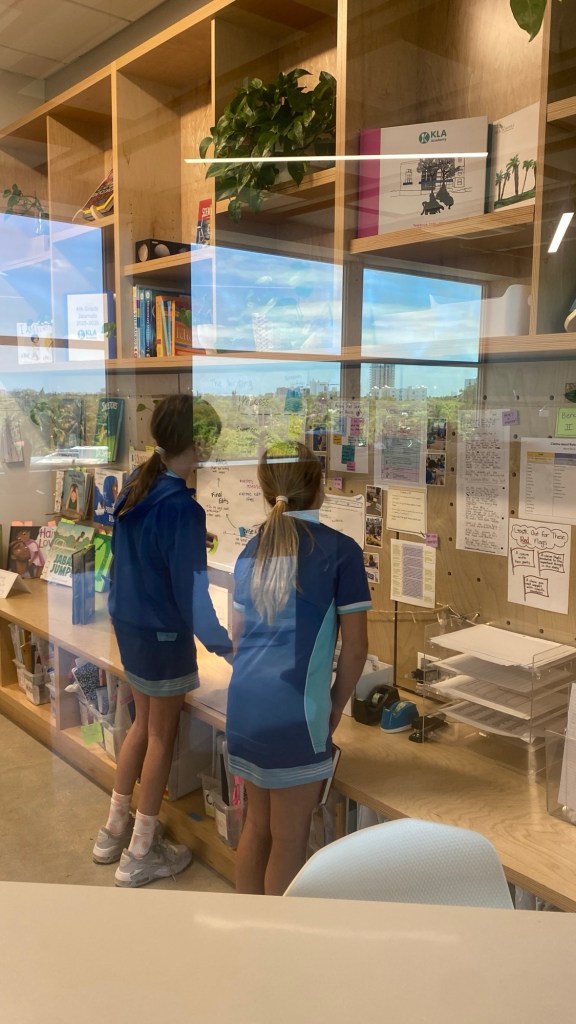
I thought I’d share some context to end this post, since this topic feels like a weird thing to be slicing and dicing about, lol.
A couple of weeks ago, I helped our 4th-grade teacher update their writing wall to launch Literary Essay. I got inspired and also got carried away. I added many items that students can benefit from, but I didn’t explain how to encourage them to keep coming back to the wall. When I walk by their room now, I see a wall with helpful tools, but also several missed opportunities to make it truly that third teacher.
Perhaps that’ll be the topic for my next Two Writing Teachers post 🙂
 Start with a Story
Ana, I love this metaphor of thinking about writing / displays as that toy box we take out or rotate from time to time. And you’re right – there is something to be said about the power of novelty, even when the “new” is just revisited or reviewed.
I’ll be thinking on this one for a while!
LikeLike
Ana, I totally agree with the environment as the third teacher and HATE when rooms are cluttered with posters that really are just relics of mini/maxi lessons for teachers. I used to try to rotate toys when my children were small, but I failed miserably and eventually my kids and clutter took over a corner of our room. Every vacation and snow day I would try anew with moments of glory and lots of remorse! I think the key may be balance and eventually we dedicated a closet to toys and games and made the one activity at a time “soft” rule that worked for a busy stretched thin mom. You really do have an important post in this that needs a wide audience for sure.
LikeLike
What a beautiful idea, Ana. Such an ambitious concept. I couldn’t agree with you more. I was always a big fan of meaningful signage but I guess I leaned more with sharing their work in every nook and cranny. I guess we all bring something different to the table. . . . and that is the beauty of being an educator. Thank-you for this meaningful slice.
LikeLike
I love the connection between the classroom space and writing walls as the third teacher with Elena’s toy rotation. I also love when you write about how your mind is working through all these ideas!
LikeLike