
I’ve written about interactive read-aloud on several occasions. The last post I wrote came from Amy’s questions when planning her own book. This time, I find myself in need of supporting new teachers at our school who aren’t familiar with this critical instructional approach.
I had some time on my schedule and a pending task to create a rough plan for Grade 3’s next book, so I picked up my pen and jotted down some ideas that I quickly felt like elaborating on.
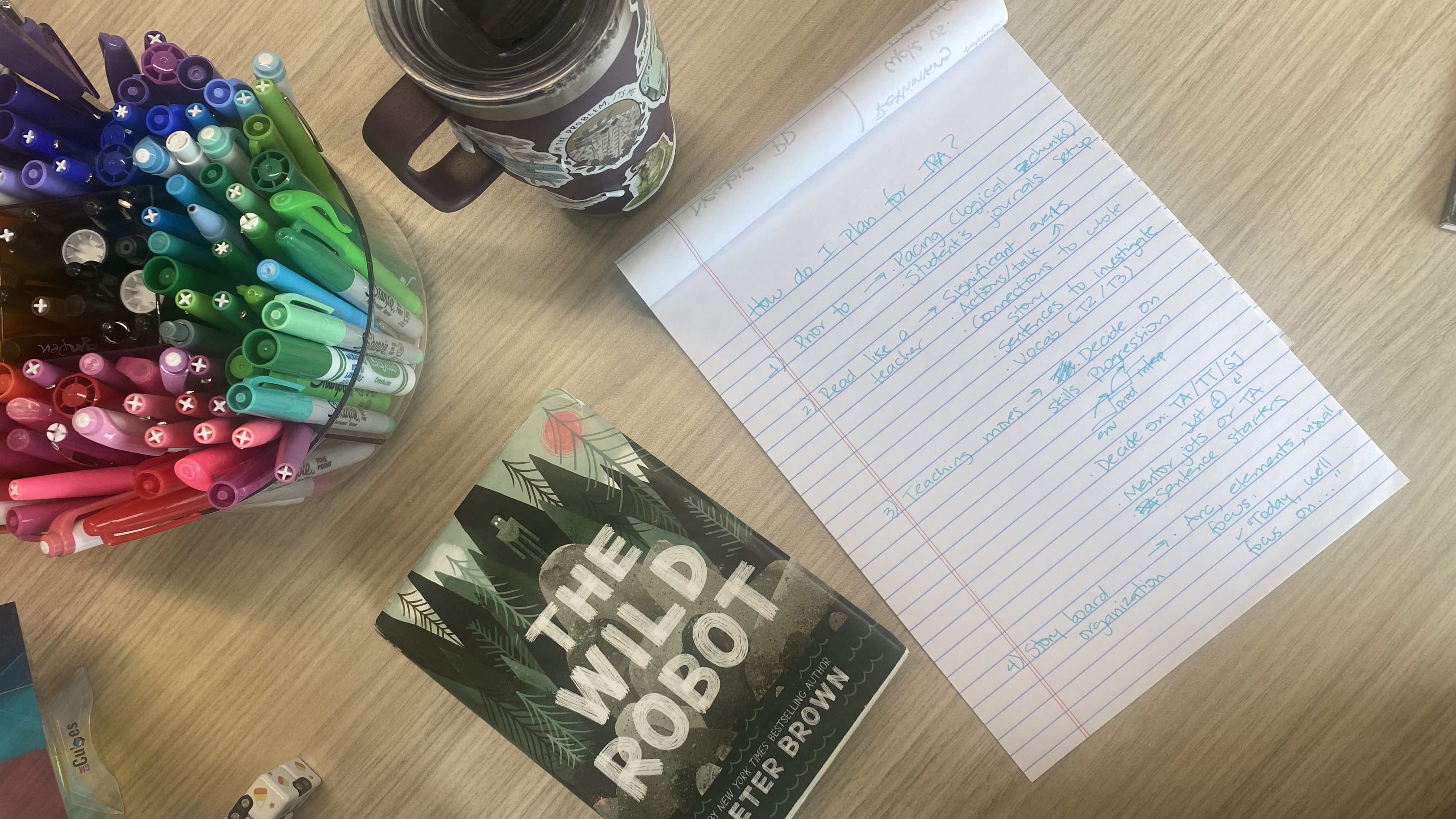
The reason we protect Read-Aloud every day on our schedules is because it’s the one moment when all students can access grade-level text without the struggles of decoding, the complexity of vocabulary, or stamina fluctuation. When an adult reads to students, there’s power in the fluency that’s modeled and the intentional pauses we take along the way.
That also means planning for read-aloud can be quite the task. Here’s my process:
Before Chapter 1
1. Pacing
Create a pacing guide to split chapters in a way that makes sense for the story’s flow. AI tools can help with this, but be mindful of AI hallucinations (false or inaccurate details).
2. Writing About Reading
Teach students how to start a new page in their reader’s journal where they’ll document all their thinking about the book. Keep your own teacher’s journal for demonstration. This is also a good place to note passages worth exploring if you run out of time in a session.
3. Skill vs. Strategy
Reading comprehension skills are built through strategies. It’s important to know the difference before we plan. I can notice a character’s reactions to obstacles [strategy] and with that, I learn to come up with theories [skill] about what kind of person that character is.
Read Like a Teacher
When you read the chapter in advance, look for:
- One significant event → This will determine where you pause for an interaction.
- Character actions or dialogue connected to the event → These moments provide context for teaching a comprehension strategy.
- Parts of the chapter that connect to the bigger plot → Model how to make chapter-to-whole text connections.
- Sentences for language study → Sentence comprehension builds reading comprehension; gather a few to analyze later.
- Words to teach → Flag Tier 2 and Tier 3 vocabulary. Use Tier 2 words for future word study activities and prepare kid-friendly definitions of Tier 3 words ahead of time to avoid awkward pauses.
Plan to Teach
You may plan using a Monday–Friday lesson template or simply jot notes on sticky notes inside the book. Either way, consider three elements: comprehension skills, teaching methods, and vocabulary work.
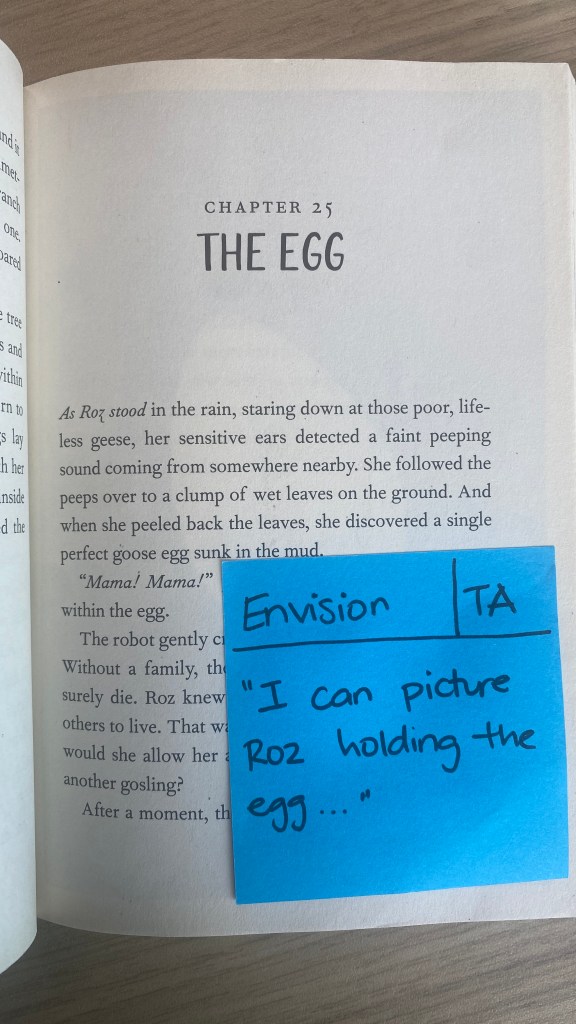
1. Comprehension Skills
Choose skills that fit the chapter’s events. Don’t hesitate to layer multiple skills since students can focus their energy on thinking rather than decoding. Sequence them in a way that builds complexity (e.g., envisioning → predicting → interpreting). Also, be intentional about the strategies you match to those skills.
2. Teaching Methods
Match methods to students’ prior exposure:
- If they’ve practiced envisioning before, use a Turn & Talk.
- If they’re new to building interpretations, model with a Think-Aloud first.
Whenever possible, use this sequence: think-aloud → turn & talk → stop & jot. Writing (stop & jot) is best saved for the end of a chapter to avoid interruptions. Sentence starters and prompts help keep their writing focused, and serves as an extra moment to explicitly teach sentence composition.
3. Vocabulary Work
- Post definitions of Tier 3 words ahead of time; no need for lengthy discussions during the read-aloud itself.
- Save Tier 2 words for a future morphology lesson—they’re the ones students will encounter most often across texts.
Extra Tip: Mentors!
Mentor jots and sentences can support students’ ability to write about reading. Post sentence starters or words you’ll use in your think-aloud so students can lean on them during turn & talks and in their own notes.
Storyboard Organization
Because novels are complex, students need visual tools to track the whole story. I recommend a large class chart that records the work from each read-aloud session. This becomes a model for how they can annotate their independent books.
Here’s how to organize the chart:
- Story Arc Anchor: Use a story arc or mountain to mark exposition, rising action, conflict, falling action, and conclusion. Students often confuse resolution vs. solution, so clarify as needed.
- Story Elements Corner: Add prompts for setting, characters, and plot:
- Setting: Does it stay the same? Change? Hold meaning?
- Characters: How do they act, respond, influence one another, or change? Pay attention to secondary characters, too.
- Plot: Which events build toward the rising/falling action?
- Daily Focus Section: Post that day’s goal. For example:
- Today, we’ll practice making mental movies to support predictions.
- Today, we’ll notice character actions to help us build interpretations.
- Today, we’ll pay attention to how characters react to events.
Final Thought
Planning for read-aloud takes time, but with a system in place, it becomes sustainable week after week. The goal is simple: make the most of every shared reading moment by pairing joyful read-aloud with intentional teaching.
 Start with a Story