
There is so much to celebrate, and I can’t go another day thinking about writing and not doing it.
The “writing playlist” is already playing song number two. I know that when I ignore this magic for too long, it keeps me waiting even longer.
One word, then the next slowly at first, a bit faster later, and it’s back to help me translate these thoughts.
When I walk around at school, I tend to go fast, like a dog searching for its hidden bone. My mission might be to grab something from the printer, snatch a new pack of post-its, or check in with Angie and Male about a meeting we’ll have later. I arrive at my destination, complete my mission, and return to my classroom.
On one particular Tuesday, I allowed myself to be distracted by something I saw. I went into one of the first-grade classrooms to return a book I had borrowed, and I saw them. Two cups, metallic, labeled. One had blue pens, and the other had black pens. The font on the labels was easily recognizable; children had written those words. Because I knew I’d want to write about this moment, I pulled my phone out and snapped a photo.
Click.

“These writers are using tools to understand the difference between the drafting and the revision process,” my mind whispered to me. I smiled.
A week later, same Tuesday, the same situation. This time, the mission was to find a squishy ball for a Morning Meeting game. It was hours after dismissal, so Amy had gone home. What distracted me this time was a writing center in a fifth-grade classroom. The same black and blue pens rested together in their bins, surrounded by mentor texts, staplers, mini-anchor charts, and a subtle but loud implicit message for writers, “Here’s all you need to make your writing possible. You’ve got this.”
Click—another photo.
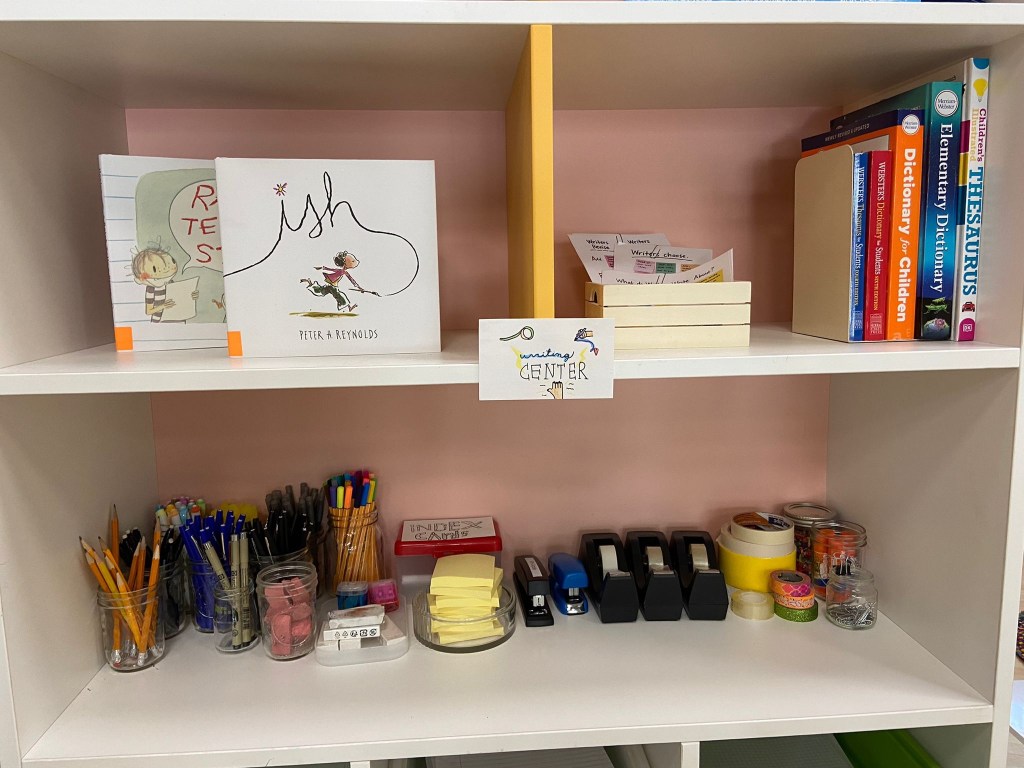
I try to capture every trace of trust in our writing work because I had never experienced something quite like this. I am in awe each day, witnessing the writing communities rise all around me. I stand there, staring at writing centers or writing folders, and I can touch the joy with the tip of my fingers.
Then, out of nowhere, I remember the many messages of frustration, distrust, and negativity that so many teachers around the world have shared about this work. I’ve seen them on Facebook and heard them in conversations in halls I no longer transit. Their opinions have always confused me. I don’t see what they see. What I’ve always seen is the wonders of children writing.
For a second, I hesitate to acknowledge what (I believe) made a difference here; I think I know what it is. I simply wanted my new colleagues to see this magic and decide for themselves.
It all started with a very selfish desire back in April 2021. I had been deprived of writing time with students for months. I missed that particular time of soft music, dashing pens transcribing ideas onto paper, and writers’ identities being created one word at a time. A selfish desire drove me to invite 16 young souls to write with me, and that desire grew into the signs of writing bliss I notice each school day.
I couldn’t attend the [first of many] writing celebrations I was invited to, and I thought for a while about how to show teachers gratitude. Then, as I scrolled through my phone looking for a photo, I saw them—the many signs of writing communities in my camera roll.
Writing centers with picture books as mentor texts, click.
Partnerships, click.
“Done for now” and “Still working on it” folders and students’ identities reflected on their notebooks, click.
Booklets, loose paper, lots of choices for independent writers, click.
Cozy spots to imagine possibilities, background music to help their genius land, stamina rising, and teachers proudly watching while writing their pieces. Click.
Signs of trust, commitment, and passion in the work of supporting writers.
Thank you, teachers.
 Start with a Story