
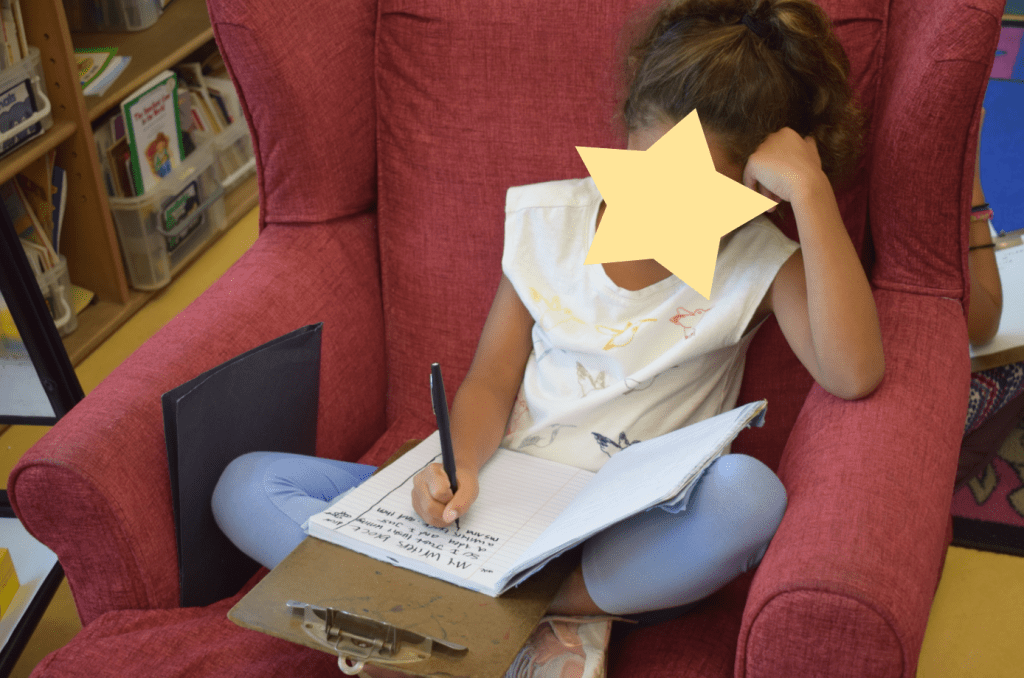
“Off you go,” I said as I got up, turned around, and started gathering my notebook, pen, and samples. Giving my back to my students, as soon as I dismissed them from the rug, became the greatest move to encourage autonomy and independence. Before, I would stay on my chair, say the words, and watch a few of them walk toward their seats. The majority though would remain on the rug, doing some of these:
- Silently looking at me, waiting for a personalized encouragement. “Go on, Amy!”
- Posing as if “thinking of a topic to write about” while also waiting for me to begin conferring with them.
- Turning and talking to another student on the rug about the photos on their writing folders. “Is that your dog?!”
- Lying down and rolling all over the rug because “I hate writing.”
I knew better now, so as soon as I said the words, I turned around and purposefully ignored them, which meant “you’ve got this!” This was the message I said to them on the first day of school to build that routine. I’ve learned that doing things without explaining the reason why I was doing them did little to solidify such routines. So, on that very first day of Writing Workshop, I gave a super short mini-lesson and said, “In a moment, I will say the words ‘off you go!’ which means get up and walk towards a seat of your choice and just write.” As I said these words, I dropped my pen on my lap and made a hand signal of releasing, freeing, giving permission to do your thing. I added, “When I say those words, I’m also telling you that I trust you, that you have everything you need, and I know you’re ready. You’ve got this.”
Once I had everything in my toolbox, I started playing the soft music they now asked for before quickly finding an empty spot on the now-empty rug for myself. I could feel the eyes of many of my students, carefully watching my every move, perhaps wondering if I was coming to see them. Sometimes I could also hear the sound of disappointment when they saw me sitting alone and writing instead of visiting them. Pen on hand, notebook on my lap, and modeling hard. “This is what we do, writers. We just get it done.” That’s the message.
This wasn’t my groove before. It was something I was taught. Before, I would grab my things quickly, shh some of them, publicly call out the one who wasn’t writing and identify the child that clearly needed me. Then, I would rush to their aid and invade their writing space with my questions, suggestions, and own writing… Ugh. I am sorry I did that to you, guys. I know better now.
“Ms. Ana, can I start drafting now?” a girl said from across the room. I kept writing, pretended I didn’t hear her. “Can I sit at your table, Ms. Ana?” another boy said while standing in front of me. This time ignoring wasn’t kind, so I responded with a smile, “You’re self-directed, and I’m writing.” Christy would be proud; she taught me well. If I want my writers to be independent and self-reliant, I have to start by modeling what that looks like, even if I have nothing to write about and just sit there, struggling as they often do. If I want them to trust themselves, I have to let them go and protect that scary transition between the safe moment called “my teacher is telling me what I could do” to “now I have to figure out what I have to do on my own.” So I leave them alone for a few minutes.
When other teachers have asked me about this strategy, they often point out common issues that I also brought up when hearing about this for the first time.
- The little ones need more guidance; they’ll start playing or fooling around if I just go and start writing.
- The chatty ones will just sit together and start talking loudly. This will distract the other ones.
- Those are precious minutes I could be using for conferring or leading a small group.
These are all valid, and what I learned is that the best way to address them is by doing exactly what I do now. I started using the “off you go” strategy in my second year teaching Kindergarten, and it took several months before my students started to gain some independence. It took a lot of patience and determination on my side, a ton of modeling, and practicing with them all year long. “Writers, today we’re going to practice how to get started with our work. We’ll watch Ms. Farrah and study what she does; then we’ll try it out together.” This often happened, especially when I noticed that things were getting messy again. It’s normal, and it’s how we build routines.
Writing wasn’t the only thing I’d do to keep me from going to a writer right away. Sometimes I would prepare materials for a small group, or my next conference. What I learned is that I needed to do whatever it took to give students those 3 minutes of transition without having an adult go to them immediately. Writing is, in my opinion, the best way to do such a thing because I feel like a hypocrite if I talk to a student about writing when I don’t do any writing myself. It’s only 3 minutes that can feel like an eternity when you hear students loudly figuring things out without you, but it isn’t that long, really.
“I think I can get up now,” I think as I gather my things again. I already have a plan of who I’ll visit, and I make sure I don’t start with the boy who isn’t writing at all or that girl who is talking to someone else. I intentionally go to an engaged writer, someone who is doing the work. I feel the eyes of those disengaged students who quickly go back to their seats when they see me move. “Can I work with you for a bit?” I ask one boy who already has a full page of writing in his notebook. Now my favorite part begins, conferring one-on-one while others write independently.
 Start with a Story
Thank you for this!!!!! Can’t wait to use it!
LikeLike
Great strategy! I will definitely try to use it this upcoming year.
LikeLike